

Free WebM to MP4 Converter
Convert WebM to MP4 for free and get H.264 video with AAC sound that phones, PCs and TVs play. It takes screen and browser recordings too, up to 1 GB each.
Drop your video files here
WEBM
Max file size: 1 GB · Multiple files supported
How to Convert WebM to MP4
Add your WebM files.
Drag recordings onto the box above or press Choose videos. Any number of .webm files works, each up to 1 GB.
Keep MP4 as the output.
It is already chosen for every file. Leave Bitrate on Auto for a medium quality level, or pick 500 to 16,000 kbps, then press Convert All.
Save your MP4 files.
Use the download button on each tile, or Download All for one ZIP once two or more are done. The original WebM files are not changed.
WebM vs MP4: What Changes
Understanding the differences between WebM and MP4 helps you choose the right format for your needs.
| Specification | WebM | MP4 |
|---|---|---|
| Compression | Lossy | Lossy |
| Quality | Good to Excellent | Good to Excellent |
| Transparency | No | No |
| Animation | Yes | Yes |
| File Size | Small to Medium | Small to Medium |
Why convert from WebM?
- Limited support on iOS and Safari
- Rarely supported by non-browser media players
- Poor support in professional editing software
Why choose MP4?
- Universal compatibility
- Excellent compression efficiency
- Supports multiple audio tracks
When to use WebM
When embedding video on the web and you need a royalty-free format with strong browser support.
When to use MP4
When you need universal video compatibility and efficient streaming.
Inside This Free WebM to MP4 Converter
It re-encodes VP8 or VP9 video as H.264 and Opus or Vorbis sound as AAC, inside a standard MP4. No sign-up and no watermark.
Turn WebM Into H.264 MP4 Files
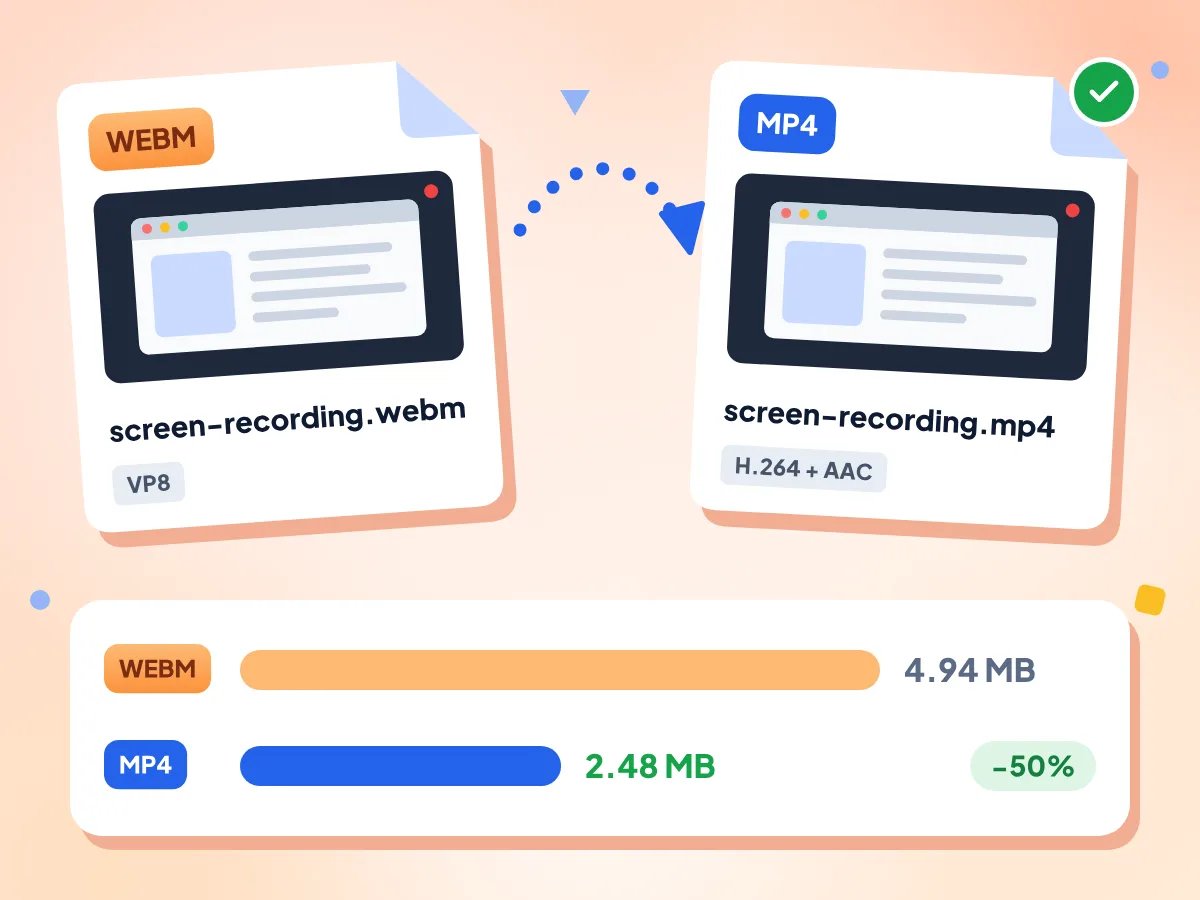
Each WebM is re-encoded, not renamed: VP8 or VP9 video becomes H.264 and the sound becomes AAC at 128 kbps. In our test a 10-second 720p recording went from 4.94 MB to 2.48 MB.
- Accepts .webm files up to 1 GB
- Reads VP8 and VP9 WebM video
- Saves H.264 and AAC in MP4
Convert WebM Screen Recordings to MP4
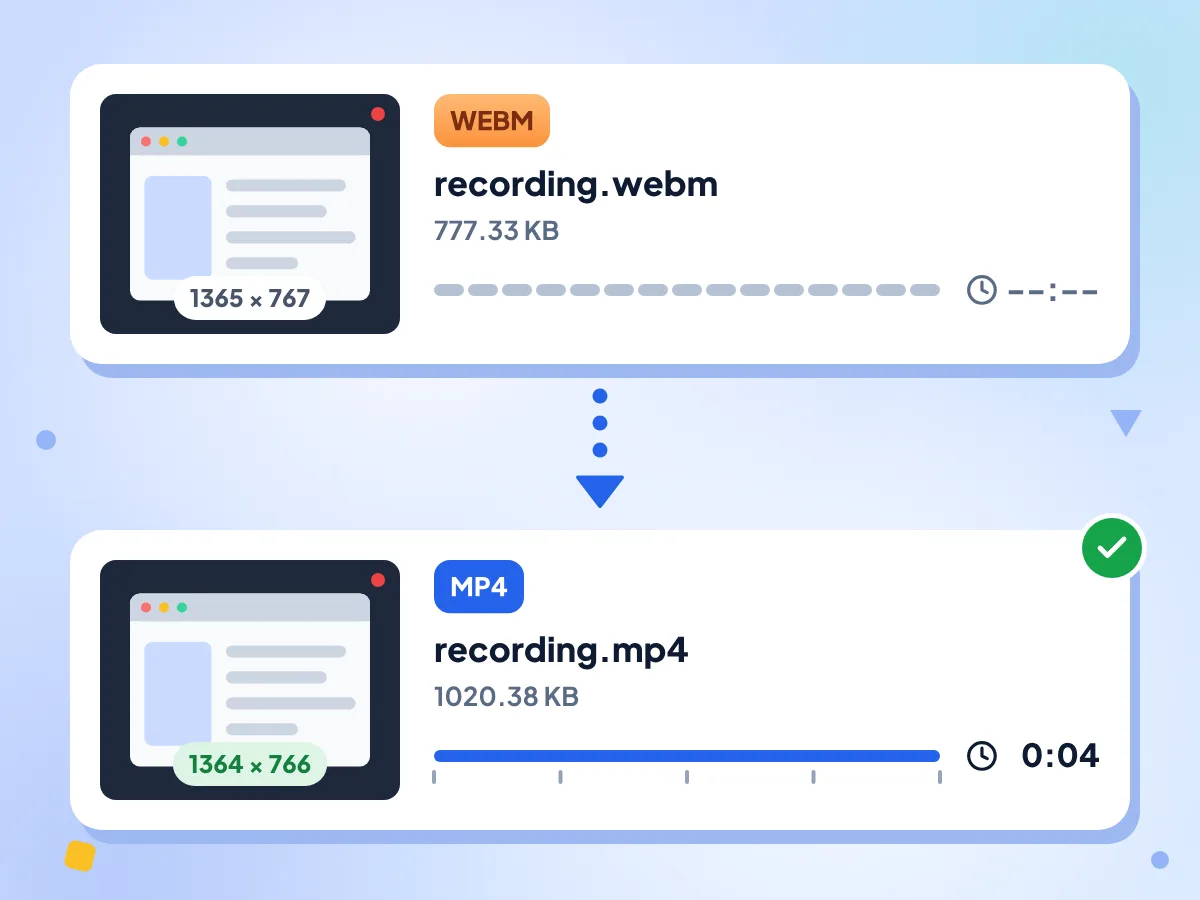
Recordings saved by browsers and screen recorders often store no length in the file. They still convert, and the MP4 gets its real duration, so players can show a normal seek bar.
- Converts files with no stored length
- Odd widths rounded to even numbers
- Sound becomes AAC at 128 kbps
Many Recordings, One ZIP
Add a stack of WebM files at once. They run in order on one engine, a failed file can be retried alone, and Download All saves two or more as one ZIP.
WebM to MP4 Conversion FAQs
Answers on quality, recordings, phones, settings and errors when you convert WebM to MP4.
How do I turn a WebM file into an MP4?
Press Choose videos or drag your .webm files onto the box, and MP4 is set for you. Press Convert All, then save each file or use Download All for a ZIP. There is no fee, account or watermark, and WebM files added later with Add More Files also get MP4.
Can I convert WebM to MP4 without losing quality?
Not fully. This tool always re-encodes, so VP8 or VP9 video becomes H.264 at a medium quality level on Auto and the sound becomes AAC at 128 kbps. Nothing is copied as is. If you need more detail, pick a Bitrate of 8,000 or 16,000 kbps.
Why is my MP4 bigger or smaller than the WebM?
Size depends on the new H.264 encode rather than on the WebM. In our tests a 10-second 720p VP8 recording went from 4.94 MB to 2.48 MB, a VP9 one from 3.44 MB to 2.63 MB, and a small 4-second clip grew by 31%.
Can I lower the bitrate or remove the sound from the MP4?
Yes. Pick a Bitrate between 500 and 16,000 kbps (Auto is the default), choose a Frame rate from 24 to 60 fps, or switch on Remove audio for a silent MP4. Each setting covers the whole batch. There is no resolution control; to cut a clip, use the Video Trimmer.
Will the MP4 play on my iPhone, TV or Windows PC?
It should. The MP4 holds H.264 video in standard 8-bit color with AAC sound, the mix phones, smart TVs and Windows apps are built to play. Its index sits at the start of the file, so web players can begin before it fully loads.
Can I convert a screen recording from Chrome or another browser?
Yes. Browser and screen recorder WebMs often store no length, which confuses some players. Such files converted fine in our tests, and each MP4 got its real duration. Because the length is unknown, the tile stays at 0% until the file is done.
Why won't my WebM file convert?
Check that it ends in .webm and is 1 GB or smaller. WebMs with AV1 video can't be read yet and show "Conversion failed"; VP8 and VP9 work. A damaged file or low memory also fails. Retry that tile while the rest carry on.
How long does WebM to MP4 take?
It runs on your own processor and re-encodes every frame, one file after another. Our laptop run of this engine needed about 25 seconds for a 10-second 720p recording and close to 2 minutes for a 1-minute screencast. The 32 MB engine downloads before the first file starts.
How do I convert WebM to MP4 on a Mac, Windows PC or iPhone?
Open this page in Safari, Chrome, Edge or Firefox; there is nothing to install. Add the .webm file, keep MP4 selected and press Convert All. On an iPhone, pick the file with the browser's file picker and save the MP4 from your downloads. Long recordings need a lot of memory on a phone.
Can I save just the sound of a WebM as MP3?
Yes. In a file's Output Format menu, the Audio tab lists MP3, WAV, AAC and OGG. Pick MP3, which saves at 256 kbps on Auto and drops the picture. Skip OGG, which still saves a video file. The WebM to MP3 converter has MP3 already picked.
Is it safe to convert private recordings here?
Yes. The MP4 is built inside this tab, and your recording never goes to our servers. The page does load the 32 MB video engine from the public unpkg host, along with ad and analytics scripts, and our analytics record page views and editor time. File names and contents are never sent.
Why Convert WebM to MP4?
For Screen and Browser Recordings
- Turn a browser screen recording into an MP4 you can email
- Share a meeting recording with people whose players refuse WebM
- Convert a recording before uploading it to a site that asks for MP4
For iPhone, Mac and Windows
- Make a WebM clip ready for an iPhone or iPad
- Open a WebM video in apps that only read MP4
- Import WebM footage into editing apps that expect H.264
For Lighter or Muted Versions
- Pick 1,000 kbps for a smaller MP4 to share
- Turn on Remove audio to drop the microphone track
- Choose a frame rate from 24 to 60 fps for the MP4
Explore More Tools
Discover other free tools that work great alongside this one